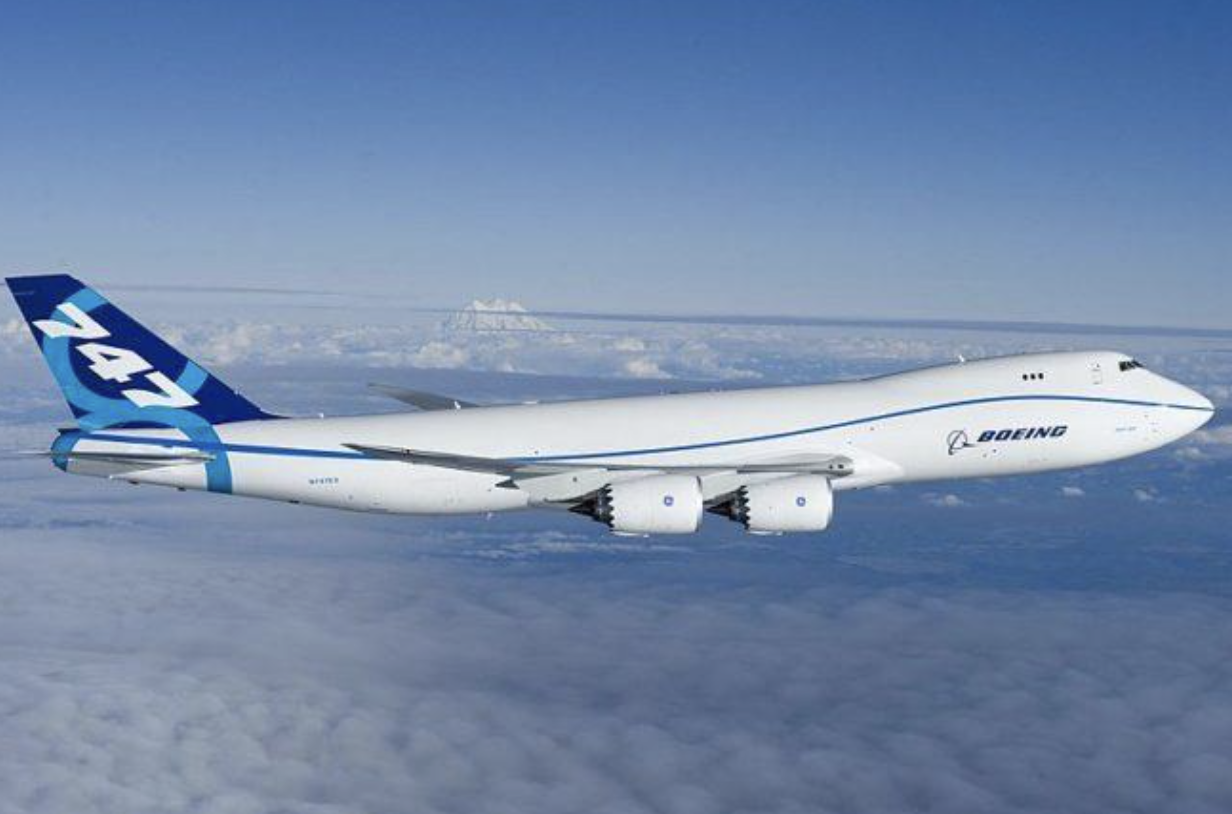
The Vancouver Airport Authority listed seafood as a primary outbound commodity from YVR, alongside cherries and mining equipment. There are strong demands at Asia Pacific's premium food market at hubs such as Shanghai and Hong Kong for British Columbia's seafood, and the Boeing 747-8F's lower deck provides the ideal configuration to deliver this commodity stream. High-value perishables include salmon, halibut, and Dungeness crab. The lower deck container volume is 148.2 m³, which can accommodate up to 22 LD1-3 containers. The LD-1 has an external dimension of 60.4 × 92.0 × 60.4 cm with a maximum gross weight of 1,588 kg (3,500 lb). The LD-1 is compatible to seafood master cartons with dry ice or gel pack refrigerant. The physical separation from the lower deck to main deck allows perishables that are temperature dependent to be cooled at the appropriate temperature without interference from the main deck's ambient temperature, and vice versa. The Boeing 747-8F uniquely offers a more substantial capacity on its lower deck than the other widebody alternatives.
The main deck, with a capacity of 692.7 m³ (24,462 ft³), can transport 34 pallets of high-density consumer electronics, semiconductor manufacturing equipment, and precision machinery from China's manufacturing and technology supply chains back to North America. Since these items are large enough to reach the aircraft's weight capacity before its volume limit, they can carry the most cargo per flight. The aircraft performance summary shows that cargo with a density of 7 lbs/ft³ or higher consistently reaches the weight limit, rather than the volume limit, resulting in the most profitable scenario.
The required turnaround equipment for a Boeing 747-8F first includes your basic safety items such as wheel chocks for every set of landing gear, cones, and Ground Power Unit (GPU) for when the Auxiliary Power Unit (APU) is shut-off to avoid significant greenhouse gas emissions. You will need lavatory and potable water service done on the aircraft, and two fueling units. For loading equipment, you will need high loaders (Unit Load Device scissor lifts) positioned at the nose and adjacent loading doors on the fuselage, and outbound and inbound cargo runners (tugs). Since freighter aircraft do not need to accommodate passengers, jet stairs replace jet bridges. The nose, side doors (upper and lower) can all be loaded and unloaded simultaneously with the consideration of Aircraft Weight and Balance calculations. Finally, a widebody pushback tractor is needed to complete the turn. All this equipment is standard in both passenger airliners and freighter aircraft (widebody), and highly trained crew and operational standards are crucial to ensure the aircraft is not damaged, or personnel injured or killed.